Attachment and Bio-Behavioural Synchrony in Dyads
Overview
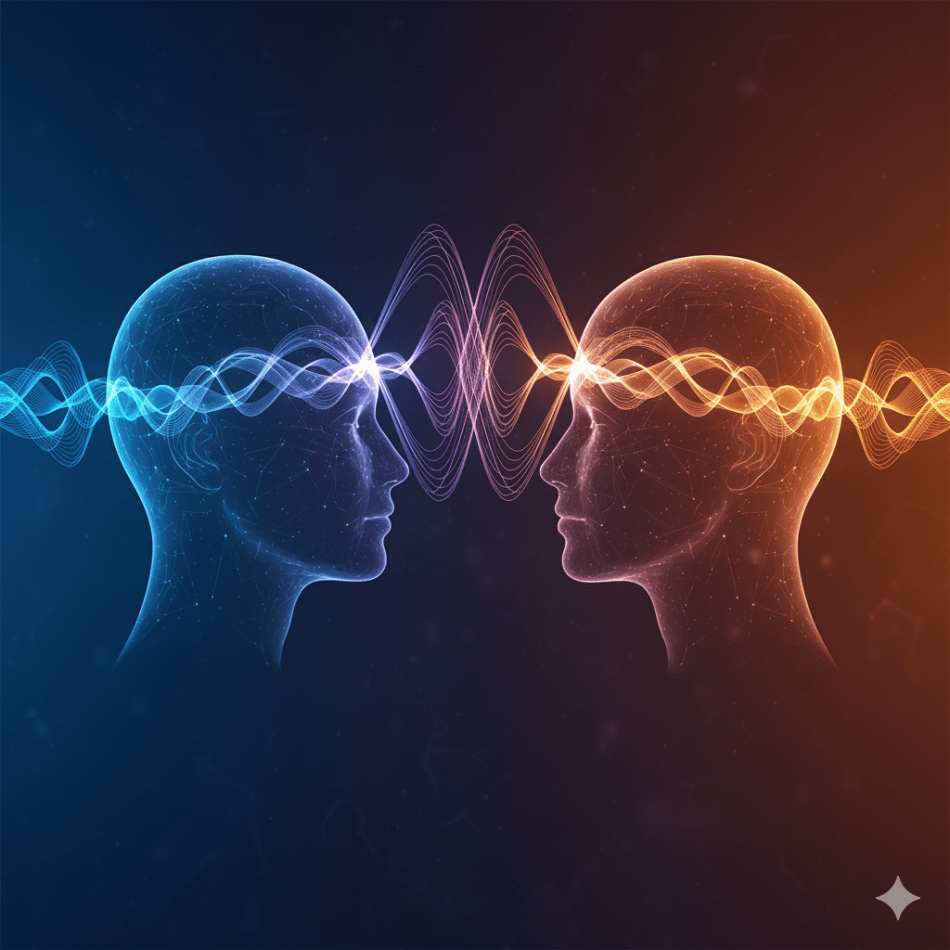
The field of social neuroscience is currently undergoing an important transition. Until recently, social cognitive and emotional processing was mostly investigated in single participants in isolation – e.g., by presenting images, videos, sounds, etc., via screens to participants that are alone during functional magnetic resonance imaging (fMRI) or electroencephalography (EEG) data acquisition. This experimental approach is nowadays referred to as “1st person social neuroscience“. However, during the last years, the focus has increasingly shifted to measuring brain activation in two (or more) people during direct and live social interaction using so-called “hyperscanning” paradigms, thereby enabling “2nd person social neuroscience“.
During 2nd person social neuroscience investigations, neural signals are simultaneously obtained from two (or more) participants and subsequently assessed for their temporal alignment or coherence, also called interpersonal neural synchrony. The same procedure can be applied for behavioural (e.g., eye gaze, touch), physiological (e.g., heart rate), and endocrine (e.g., secretion of oxytocin and cortisol) measures. This combination of measures is summarised under the umbrella term bio-behavioural synchrony pioneered by Ruth Feldman. For a very nice recent overview of bio-behavioural synchrony in general, and within the context of parent- (and particularly mother-) child interaction, attachment, and caregiving more specifically, see here.
Bio-behavioural synchrony is a fundamental component of social interactions, and particularly important in early life. By attuning one’s physiological and emotional states, parents help co-regulating their children’s allostasis and thereby ensure children’s immediate survival. Bio-behavioural synchrony also plays a vital role for learning and socio-emotional and cognitive development and thus “growing their social brains”.
Bio-behavioural synchrony is usually most prominent within intimate / close emotional bonds and thus tightly linked to attachment and caregiving. The SoNeAt Lab is investigating bio-behavioural synchrony, and particularly its neural component of interpersonal neural synchrony, from an attachment perspective. Our 2nd person social neuroscience technique of choice to assess interpersonal neural synchrony is functional near-infrared spectroscopy (fNIRS) hyperscanning.
Cautionary note: Although bio-behavioural synchrony is important for child development and secure attachment formation, more synchrony is not necessarily better…!
Relevant Talk Recordings & Articles

A 45-minute keynote about SoNeAt Lab’s fNIRS hyperscanning research in association with interindividual differences in attachment and caregiving between mums, dads and kids (“Are we on the same wavelength? Individual differences in interpersonal neural synchrony“) is available online (talk presented by Dr Pascal Vrticka on September 22, 2022 at the Affect, Personality and the Embodied Brain (APE) Meeting 2022).
A short 30-minute presentation of SoNeAt Lab’s fNIRS hyperscanning research investigating bio-behavioural synchrony, interpersonal neural synchrony, and attachment (“Bio-behavioural synchrony and inter-brain coherence: an attachment perspective“) is available as a YouTube video (talk by Dr Pascal Vrticka on June 13, 2020 at the virtual conference Neurosync 2020).
Another 45-minute overview of Social Neuroscience, outlining both 1st and 2nd person social neuroscience research performed within the SoNeAt Lab (“Social Neuroscience – From 1st to 2nd Person Paradigms“) is available to view here (talk by Dr Pascal Vrticka from March 18, 2021 at a virtual seminar for the Gwangju Institute of Science and Technology (GIST), Gwangju, South Korea & Institute of Electrical and Electronics Engineers (IEEE), Gwangju Section, South Korea).
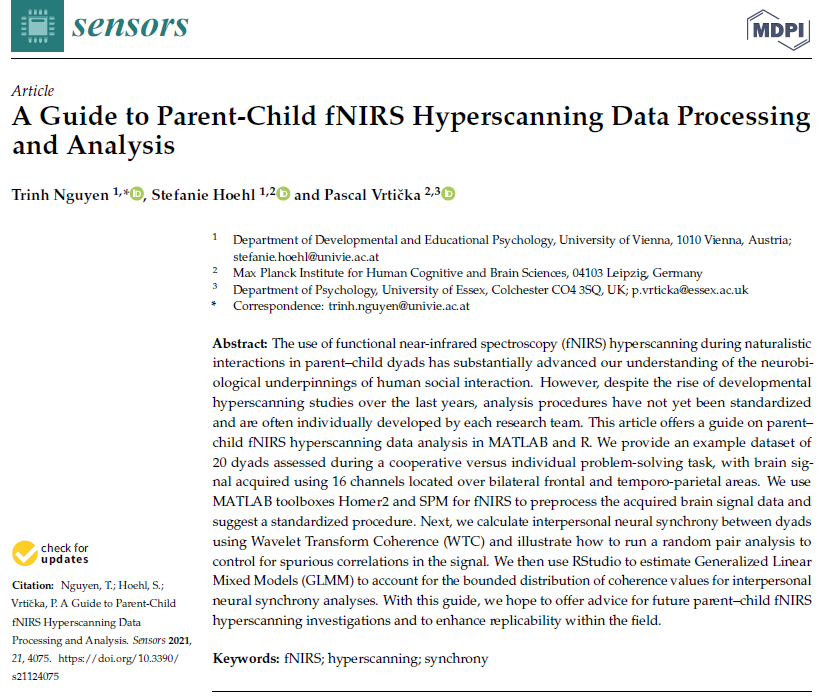
If you are interested in fNIRS hyperscanning, particularly within parent-child dyads, there now is a special methods paper available, in which we offer a detailed analysis guide. We also provide a freely available exemplary dataset of 20 dyads (randomly sampled from the M-CARE participant pool), as well as MATLAB and R scripts to analyse the data.
With this guide, we hope to offer advice for future parent-child fNIRS hyperscanning investigations and to enhance replicability within the field.
Nguyen, T., Hoehl, S., and Vrtička, P. (2021). A Guide to Parent-Child fNIRS Hyperscanning Data Analysis. Sensors (Section Biosensors; Special issue on “Brain Signals Acquisition and Processing”), 21, 4075. https://doi.org/10.3390/s21124075. OPEN ACCESS.
Summary of Research Studies and Published Articles
First study at Stanford University
In a project at Stanford University, we looked at interpersonal neural synchrony in 8-13 year old children and their mothers. The corresponding paper is published in Neuropsychologia – see here and on the publications page. The background and results of this paper can also be further explored in one of the blog posts on this website and coverage by Science Trends. Attachment in children towards their mothers was measured using a child version of the self-report questionnaire Experiences in Close Relationships revised (ECR-RC).
CARE Studies (Max Planck Institute CBS Leipzig & University of Essex, Colchester, UK)
In the context of our CARE studies, we assessed bio-behavioural synchrony between 5-6 year-old children and their parents (both mothers and fathers) during a collaborative puzzle-solving task, free verbal conversation and pre-school sheet solving. Brain activity was obtained by fNIRS hyperscanning and the parent-child interaction was video-recorded and coded for behavioural synchrony. Attachment was measured by means of self-report questionnaires, narrative measures (Adult Attachment Interview in parents and a story completion task in children), as well as behavioural coding (sensitivity).
A first paper on mother-child bio-behavioural synchrony during a collaborative puzzle-solving task is published in Cortex: Nguyen, T., Kayhan, E., Schleihauf, H., Matthes, D., Vrtička, P., Hoehl, S. (2020). The effects of interaction quality on neural synchrony during mother-child problem solving. Cortex, Volume 124, Pages 235-249. OPEN ACCESS. For a summary, see this blog post.
A second paper on mother-child bio-behavioural synchrony during free verbal conversation is published in SCAN: Nguyen, T., Schleihauf, H., Kayhan, E., Matthes, D., Vrtička, P., Hoehl, S. (2021). Neural synchrony in mother-child conversation: Exploring the role of communicative features. Social Cognitive Affective Neuroscience. OPEN ACCESS. More information is available here and for a summary, see this blog post.
A third paper on father-child bio-behavioural synchrony during a collaborative puzzle-solving task is available in Child Development: Nguyen, T., Schleihauf, H., Kungl, M., Kayhan, E., Hoehl, S., Vrtička, P. (2021). Interpersonal neurobehavioral synchrony during father-child problem solving: An fNIRS hyperscanning study. Child Development. *= these authors share senior authorship. OPEN ACCESS. More information is also available in the two press releases from the University of Essex (English) and University of Vienna (German).
A fourth paper on mother-child and father-child bio-behavioural synchrony during a collaborative puzzle-solving task with attachment measures obtained from both parents and children is available in Developmental Science: Nguyen, T., Kungl, M., Hoehl, S., White, L. O.§, Vrtička, P.§ (published online 24 March 2024). Visualizing the Invisible Tie: Linking Parent-Child Neural Synchrony to Parents’ and Children’s Attachment Representations. *= These authors share first authorship. §= These authors share last authorship. OPEN ACCESS. More information is also available in press releases from the University of Essex and University of Erlangen-Nürnberg (German). For an accessible summary, see also here.
An accessible summary on “Synced brains: how to bond with your kids – according to neuroscience” is furthermore available via The Conversation UK.
ARC Study (Max Planck Institute CBS Leipzig)
In another study, we focused on bio-behavioural synchrony between romantic partners. We obtained neural synchrony with fNIRS hyperscanning, physiological synchrony by measuring heart rate and heart rate variability, and endocrine synchrony by means of salivary cortisol. These data are not yet published. More information will be made available soon.
TRIO Studies (University of Essex, Colchester, UK)
In a new set of family interaction studies, we are currently assessing bio-behavioural synchrony in families (mum, dad, child). This includes neural synchrony with fNIRS hyperscanning, behavioural synchrony via video-recording and physiological synchrony with heart rate, heart rate variability and blood pressure. TRIO Study I has just started. More updates will follow.
Special focus on dads
Please note that there is an additional page on Dr Vrticka’s website specifically dedicated to Caring Dads: The Social Neuroscience of Attachment & Caregiving in Fathers.
 Dr Pascal Vrticka (PhD, FHEA)