
potential match/ mismatch between acquired and required skills due to a complex interplay between social
and pre-academic skills acquired in preschool which function as prerequisites in the school context.
Figure developed by Dr Hannah Ihme and Prof Lars White (SWITCH Funding Application, 2024).
Since April 2025, the SoNeAt Lab is part of an international research project “Targeting Social Wellbeing to Improve Transitions to School (SWITCH). SWITCH is joint-funded by CHANSE (Collaboration of Humanities and Social Sciences in Europe, a joint initiative of 27 research funding organisations from 24 countries) and NORFACE (New Opportunities for Research Funding Agency Cooperation in Europe) with a funding amount of €1.5 million over three years. More information about the funding call and project can be found here.
As part of SWITCH, an international team of experts – led by Prof Lars White (University of Bremen, Germany), Prof Tina Malti and Dr Greiner-Döchert (University of Leipzig, Germany), Prof Stefanie Hoehl (University of Vienna, Austria), Assoc Prof Pascal Vrticka (University of Essex, UK) and Assoc Prof Rebecca Boehme (Linköping University, Sweden) – have joined forces with three main objectives.
1. Large-Scale Cross-National Study
SWITCH will recruit five large-scale representative samples of preschool/reception-aged children across four European countries (Germany, Sweden, the UK, and Austria), with approximately 1,000 participants per site. Parents and teachers will provide valuable insights on children’s well-being and mental health one year prior to school entry / in the UK during reception. Likewise, SWITCH will assess sociodemographic factors and children’s age allowing us to compare cohorts regarding variations in school-entry practices within and between countries.
2. In-depth Subsample Analysis
From these larger samples, SWITCH will select subsamples of children (approximately 80 per site). These children will participate in two intensive lab sessions, one during preschool/reception and one during Year 1. In these more extensive sessions, SWITCH will assess children’s social, cognitive, and early literacy and numeracy skills to explore how these factors shape their social wellbeing. We will also conduct detailed evaluations of their key relationships—with parents, peers, and teachers—as well as measure interpersonal bio-behavioral and neural synchrony (first in parent-child and subsequently in peer-child dyads).
3. Long-Term Outcomes and Policy Recommendations
SWITCH will track the full sample to assess how social wellbeing affects mental health, overall well-being, and academic skills by the end of Year 1. Based on these findings, we will provide evidence-based guidelines to policymakers, highlighting strategies to support social wellbeing during this crucial transition.
By pursuing the above three main objectives, the SWITCH project aims to provide critical insights into how children’s social wellbeing fosters optimal opportunities for education and development during this fundamental early transition.
Please see below for more information on:
► Main Project Elements
► Specific Project Information
► Call for Participation
► Output: Talks & Presentations
► Open Positions
Main SWITCH PROJECT Elements

►fNIRS hyperscanning during several tasks, first in parent-child and then in child-peer dyads. This will serve to derive longitudinal measures of interpersonal neural synchrony.
►Behavioural observation during the fNIRS hyperscanning sessions. This will serve to derive measures of interaction quality according to several attachment-theory derived coding schemes.
►Questionnaires filled in by parents and teachers to provide insights into child development and temperament.
►Interviews with children to assess their social cognition and attachment representations.
Specific SWITCH Project Information
1st Wave
From Spring 2025
Initial recruitment of the full sample and first set of self-reports provided by parents.
2nd Wave
From Autumn 2025
Selection of the subsample (children in Reception with one of their parents) and first lab-based measurement session including parent-child fNIRS hyperscanning and behavioural observation.
3rd Wave
From Autumn 2026
Second lab-based measurement session including child-peer fNIRS hyperscanning and behavioural observation (same children as in the 2nd wave but now in Year 1 together with one of their peers).
4th Wave
From Spring 2027
Second set of self-reports provided by parents, complemented by self-reports provided by school teachers.
Call for Participation in SWITCH
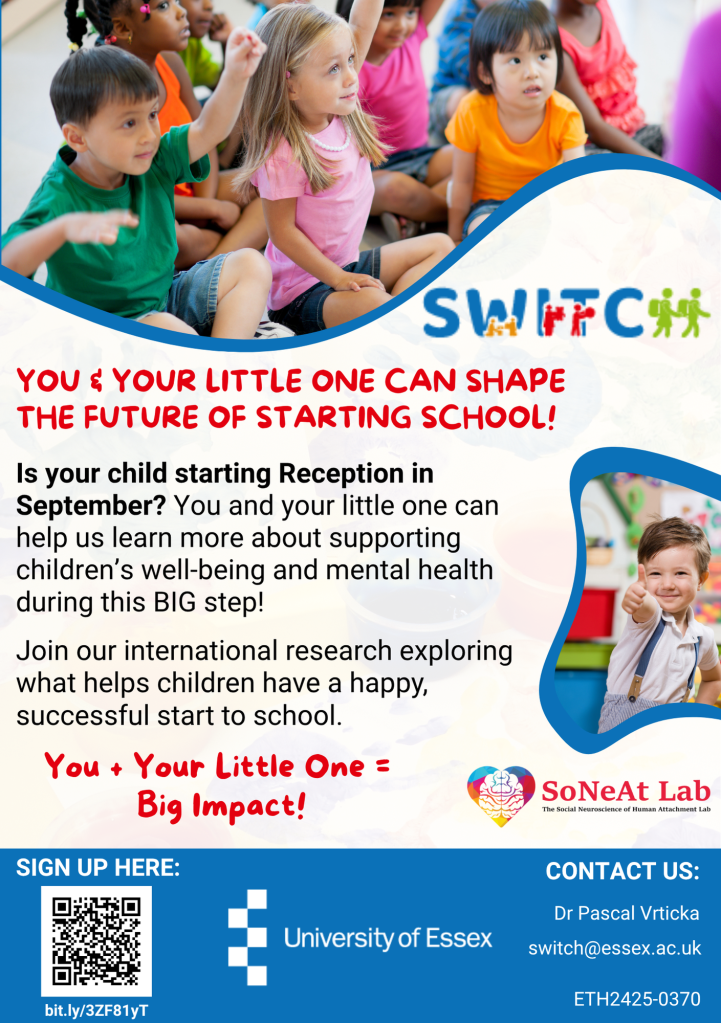
We are now looking for participating families. More information can be found in the flyer below. Please do not hesitate to contact us in case of any questions: switch@essex.ac.uk.
Output: Talks & Presentations
More information will follow shortly. Thank you for your patience.
For more talks & presentations, please also see Dr Pascal Vrticka’s overall Talks & Presentations page.
Open Positions
There are no current open positions. Please check back later.
More information about the SWITCH Project will be posted here once it becomes available.
 Dr Pascal Vrticka (PhD, FHEA)